Portable projectors have revolutionized the way we present information, entertain, and share experiences. Unlike traditional projectors that are often bulky and require a dedicated space, portable projectors are designed for mobility and convenience. Their compact size allows users to easily transport them from one location to another, making them ideal for business presentations, home entertainment, and educational purposes.
The mechanics behind these devices involve a combination of optics, light sources, and digital processing technologies that work together to create high-quality images on various surfaces. At the heart of a portable projector is its ability to project images from a variety of sources, including laptops, smartphones, and tablets. This versatility is made possible through the integration of multiple connectivity options such as HDMI, USB, and wireless capabilities.
The mechanics of how these projectors function also involve the manipulation of light through lenses and mirrors, which help to focus and enlarge the image being projected. Understanding these fundamental mechanics is essential for users who wish to maximize the potential of their portable projectors in different settings.
Key Takeaways
- Portable projectors use a combination of light sources, lenses, and imaging technology to project images and videos onto a screen or surface.
- The key components of portable projectors include the light source, imaging technology, lenses, and cooling system.
- Portable projectors work by using a light source to create an image, which is then processed and projected onto a surface through a lens system.
- Ideal applications for portable projectors include business presentations, home entertainment, education, and outdoor events.
- The advantages of using portable projectors include their compact size, versatility, and ability to project high-quality images in various settings.
The Components of Portable Projectors
The construction of portable projectors involves several key components that contribute to their functionality and performance. One of the most critical elements is the light source, which can vary from traditional incandescent bulbs to more modern LED or laser technologies. LED projectors are particularly popular due to their energy efficiency and longer lifespan compared to conventional bulbs.
Laser projectors, on the other hand, offer superior brightness and color accuracy, making them suitable for environments with high ambient light. Another essential component is the imaging technology used in portable projectors. The two most common types are Digital Light Processing (DLP) and Liquid Crystal Display (LCD).
DLP projectors utilize micro-mirrors to reflect light and create images, while LCD projectors use liquid crystals to modulate light. Each technology has its advantages; for instance, DLP projectors tend to produce sharper images with better contrast ratios, while LCD projectors are known for their vibrant color reproduction. Additionally, portable projectors often include built-in speakers, battery packs for wireless operation, and user-friendly interfaces that enhance the overall user experience.
How Portable Projectors Work
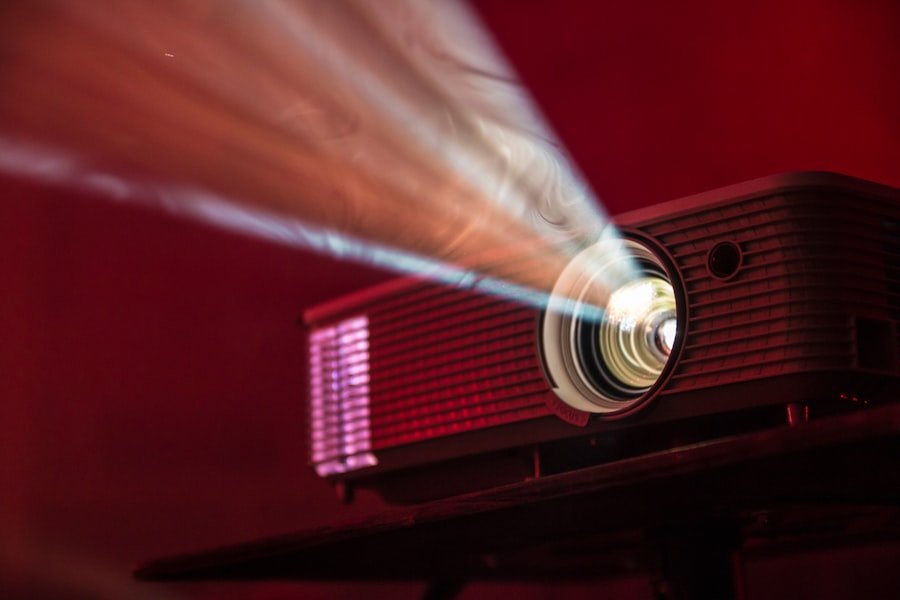
The operation of portable projectors hinges on a series of processes that convert digital signals into visible images. Initially, the projector receives input from a connected device, which sends a video signal that contains the information to be displayed. This signal is processed by the projector’s internal circuitry, which translates it into a format suitable for projection.
Depending on the technology used—DLP or LCD—the projector will then manipulate light accordingly. In a DLP projector, a light source illuminates a digital micromirror device (DMD), where thousands of tiny mirrors tilt to reflect light toward the lens or away from it, creating pixels on the screen. The rapid switching of these mirrors allows for the creation of dynamic images with varying brightness levels.
Conversely, an LCD projector uses a light source that passes through liquid crystal panels, which modulate the light to create images based on the input signal. The final step in both processes involves projecting the image through a lens onto a screen or wall, where it can be viewed by an audience.
Ideal Applications for Portable Projectors
| Application | Description |
|---|---|
| Business Presentations | Portable projectors are ideal for presenting slideshows, charts, and graphs in a professional setting. |
| Education | Teachers can use portable projectors to display educational videos, presentations, and interactive lessons in the classroom. |
| Home Entertainment | Portable projectors can be used to create a home theater experience for watching movies, TV shows, and sports events. |
| Outdoor Events | Portable projectors are great for outdoor movie nights, backyard parties, and other outdoor gatherings. |
| Art and Design | Artists and designers can use portable projectors for tracing, enlarging, and displaying their work. |
Portable projectors are incredibly versatile tools that can be employed in various settings. In business environments, they are invaluable for presentations and meetings. Professionals can easily set up a portable projector in conference rooms or even in informal settings like coffee shops to showcase slideshows or videos.
The ability to connect wirelessly to laptops or mobile devices enhances flexibility, allowing presenters to move around freely while engaging with their audience. In educational contexts, portable projectors serve as powerful teaching aids. Educators can use them to display multimedia content in classrooms or during workshops, facilitating interactive learning experiences.
They are particularly useful in outdoor settings or locations without fixed projection equipment. Furthermore, portable projectors have found their niche in home entertainment systems. Movie enthusiasts can create a cinema-like experience in their living rooms or backyards by projecting films onto large surfaces, making gatherings more enjoyable and immersive.
Advantages of Using Portable Projectors
The advantages of portable projectors extend beyond mere convenience; they offer significant benefits in terms of functionality and user experience. One of the primary advantages is their compact size and lightweight design, which make them easy to transport and set up in various locations. This portability allows users to adapt quickly to different environments without being constrained by fixed installations.
Another notable benefit is the flexibility in connectivity options that many portable projectors provide. With support for HDMI, USB-C, and wireless connections like Wi-Fi and Bluetooth, users can connect multiple devices seamlessly. This versatility not only enhances usability but also caters to diverse presentation needs.
Additionally, many portable projectors come equipped with built-in batteries, enabling operation without being tethered to a power source—ideal for outdoor events or impromptu presentations.
Considerations When Choosing a Portable Projector
When selecting a portable projector, several factors should be taken into account to ensure it meets specific needs and expectations. One critical consideration is brightness, measured in lumens. A higher lumen rating indicates a brighter image, which is essential for environments with ambient light.
For instance, a projector with at least 2,500 lumens is generally recommended for well-lit rooms, while those intended for darker settings may require lower brightness levels. Resolution is another important aspect to consider. The clarity of the projected image depends significantly on the resolution supported by the projector.
Common resolutions include SVGA (800×600), XGA (1024×768), and Full HD (1920×1080). For professional presentations or high-definition content viewing, opting for a projector with at least 1080p resolution ensures sharp images and detailed visuals. Additionally, users should evaluate connectivity options based on their devices; compatibility with smartphones or laptops can greatly enhance usability.
Tips for Setting Up and Using a Portable Projector
Setting up a portable projector effectively can significantly impact the quality of the presentation or viewing experience. First and foremost, it is essential to choose an appropriate surface for projection—ideally a flat wall or screen that minimizes distractions and enhances image clarity. If using a wall, consider painting it with projection-friendly paint to improve brightness and contrast.
Positioning the projector correctly is also crucial; it should be placed at an optimal distance from the screen based on its throw ratio. Many portable projectors come with adjustable focus features that allow users to fine-tune the image sharpness once positioned correctly. Additionally, ensuring that all cables are securely connected and that any necessary software updates are completed before use can prevent technical issues during presentations.
Future Developments in Portable Projector Technology
The future of portable projector technology appears promising as advancements continue to emerge at a rapid pace. One area poised for significant growth is the integration of smart technology into portable projectors. Many manufacturers are now incorporating features such as built-in streaming capabilities and smart assistants like Google Assistant or Amazon Alexa.
This evolution allows users to access content directly from the projector without needing additional devices. Furthermore, developments in laser technology are likely to enhance brightness and color accuracy even further while reducing energy consumption. Miniaturization of components will also lead to even smaller and lighter models without compromising performance.
As augmented reality (AR) and virtual reality (VR) technologies advance, we may see innovative applications where portable projectors can create immersive experiences by projecting interactive content onto physical spaces. In conclusion, portable projectors represent a significant advancement in presentation technology, offering versatility and convenience across various applications. As technology continues to evolve, these devices will likely become even more integral to how we communicate and share information in both personal and professional settings.
FAQs
What is a portable projector?
A portable projector is a compact device that can display images, videos, or presentations onto a flat surface such as a wall or screen. It is designed to be easily transported and set up in different locations.
How do portable projectors work?
Portable projectors work by using a light source, such as an LED or laser, to project an image onto a surface. The image is created by passing light through a series of lenses and mirrors, which then magnify and focus the image onto the desired surface.
What are the best uses for portable projectors?
Portable projectors are commonly used for business presentations, classroom instruction, home entertainment, and outdoor movie nights. They are also popular for use in small meeting rooms, trade shows, and other events where a larger display is needed.